


Sermon on October 19, 2025
“River of Life, River of Prayer”
By: The Very Rev. Pamela Dolan
I’m almost certainly going to get this story a little wrong, but I hope you’ll bear with me.
Perhaps it happened at a monastery, an ancient place hidden on a craggy mountainside or perhaps it was a school of rabbis in a remote desert town. Wherever it was and whenever it took place, the story goes that some very devout men were gathered at the deathbed of their wisest elder, a teacher and scholar known for his mystical insight and profundity. So many of his followers were there that they couldn’t all fit in his room but spread out into the hallway and the courtyard and rooms beyond it.
The most devoted of his followers stood next to his bed, leaning in close in case his teacher should offer any last words of wisdom. Finally, the rabbi or monk or mystic said, “Listen, my child, and remember: Life is a river.” The disciple turned to the person next to him and said, “Teacher says, ‘Life is a river.’” And that person whispered the message to the next person and so on. Finally, the very least of the disciples, the last one to receive the message, heard it and paused. Hesitating, he spoke up and asked, “But what does that mean? How is life a river?”
After a while, the question was relayed back up the chain of disciples, until the one closest to the dying man leaned in to him again and said, “But, honored teacher, how is life a river?” And the wise man slowly opened his eyes and with his last breath said, “Okay, maybe life isn’t a river.”
Today’s Gospel passage is about praying always and not giving up hope, and it has spawned an awful lot of commentary about what prayer is and how it works. The primary difficulty is that we’re most likely to see ourselves in the person of the persistent widow, the relatively powerless figure who nonetheless has her petition answered because she simply won’t stop beating against the door of the powerful judge. The reason this is problematic is that Jesus makes clear that God isn’t an unjust judge, but rather that God speedily responds to those who cry out to him day and night. And this raises another problem, which is that it clashes with the reality that many of us have experienced in life.
I won’t make you raise your hands, but if I asked how many of you have ever prayed for something and not had your prayer answered in the way you hoped it would be, I think I would see a lot of hands. Sometimes preachers use this as a teachable moment, insisting that we believe our prayers are not answered, but that actually the answer is no, that God is denying us because we are praying for the wrong things, and God will not give us anything that is not good for us. I have a hard time with this reasoning. It turns God into a paternalistic Santa Claus figure, as if we are all children praying for candy and kittens and toys, but Santa God has decided to give us an electric toothbrush and warm socks instead. (To be honest, the older I get the more I think that an electric toothbrush and warm socks sound like pretty good presents, but I digress.)
Maybe sometimes our prayer life is like that, but that hardly explains the mystery and pain of desperate prayers that go unanswered. All we have to do is bring to mind the countless mothers in different parts of the globe who right this very minute are praying for food and medicine for their children, and this superficial theodicy turns to dust and ashes. Sometimes even when we pray for the right thing, the good thing, for health and healing and wholeness for ourselves or for someone we love or for a stranger or even an enemy, sometimes we still don’t get it. This is a hard, hard thing to acknowledge from the pulpit, but pretending otherwise doesn’t get us very far in our life of faith.
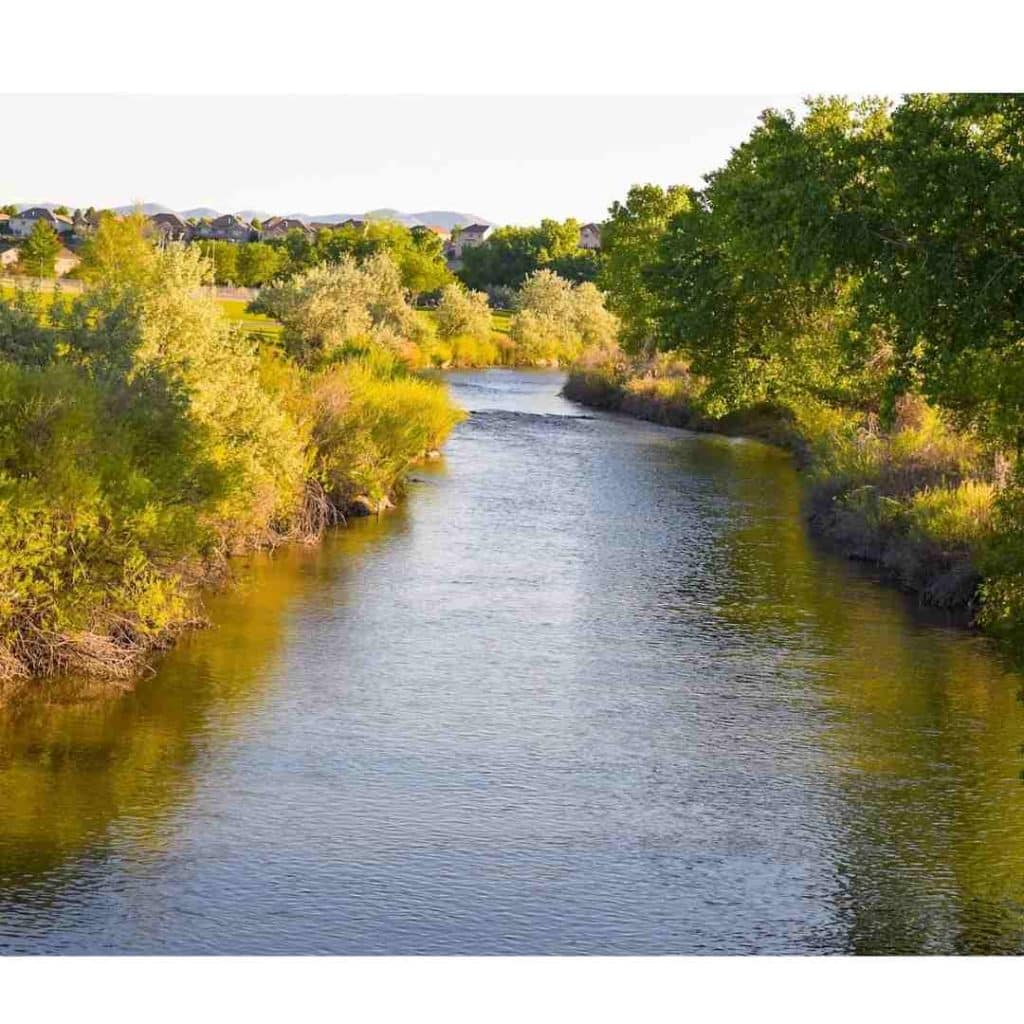
Is there some better metaphor for prayer that integrates the hard realities of unanswered prayer without causing us to lose faith? It might not be that far off to say that prayer is like a river. (Yes, seriously.) Think about the advice to “pray always” or “pray without ceasing.” I’m not sure how it’s possible to do that if we think of prayer primarily as an activity, a mental effort at communication, let alone an ceaseless series of petitions and demands. How exhausting for us and for God!
But if prayer is a river, an ongoing, ceaseless stream of communion that originates with God, then to “pray always” means to give ourselves over to that river, to let ourselves be always receptive to its flow, whether we’re aware of it or not. This is the kind of prayer that is not about asking or being answered, but is about relationship, connection, being put in touch with the source of all that is. It doesn’t take effort to experience that kind of prayer in the same way that it doesn’t take effort to float in salt water. It takes release, the absence of effort. It also takes practice, and patience, and trust.
It’s possible that there are nearly as many kinds of prayer as there are people in the world, so I also want to commend to you the metaphor of prayer as wrestling. This is of course beautifully illustrated by the story of Jacob wrestling with an angel, or with God, depending on your interpretation of today’s passage from Genesis. This is how prayer feels when I hit upon a really thorny scripture passage, or when I have an interpersonal situation that is driving me crazy, or when the injustices in the world pile up unbearably, and I really want God to figure it out for me, to make it make sense, or better yet just this once to just fix it already—and I don’t want to let go until that happens.
The story of Jacob wrestling all night and facing the next day with both a new name and a limp, is an encouraging story to me. It is also so subversive. Did you notice that Jacob prevails in this wrestling match? This story makes me think that God delights in our wrestling, not in a sadistic way of wanting to watch us struggle in vain, but in the way that a good parent can delight in a child finally besting him at chess or getting a better time in a marathon or even just taking on some challenge that the parent never could have imagined. This kind of wrestling is a bit like a baby bird making its way out of its shell; the process can be hard and scary, but it builds up the muscles and nutrients the bird needs to come fully to life in the world.
If the experience of prayer as a river is primarily about letting go, then the wrestling type of prayer requires us to dig deep and not give up. Surely that is what Jacob and the widow have in common—their persistence. Both exhibit the faithfulness of those who believe God is there with us, engaged with us in the struggle and the pain, whatever the outcome.
However you define or experience prayer, I hope you will agree that the world needs more of it, and explore ways that everything you do can take on an aspect of prayer, when done with faithfulness and a desire to be in the presence of God. Prayer and action are not opposites; they are necessary parts of a whole, and one can even become the other. Being in nature can be prayer. Protesting against tyranny and fighting injustice can be prayer. Baking cookies for a neighbor can be prayer. Binding up the wounds of another can be prayer. Wherever you are your best and most authentic self, reaching out beyond the confines of isolation and competition, you are praying, and your prayer is making a difference in the world. May we all find the river of prayer wide and inviting, and the current gentle, until it carries us home. Amen.
OTHER RECENT SERMONS
- “Rich Man, Poor Man”: Sermon by Rev. Pamela 10/4/2026Sermon on October 4, 2026“Rich Man, Poor Man”By: The Very Rev. Pamela DolanPrimary scripture source: Luke 12: 13-21 Have you ever heard of the Windigo? I go out of my way to avoid scary stories, even during the “spooky season” of October, so the myth of the Windigo was new to me until quite recently. I promise I won’t include any graphic details, but I do want to share an explanation of the myth from the author Robin Wall Kimmerer, who writes, “The ‘monster’ in Potawatomi culture is Windigo, who suffers from the illness of taking too much and sharing…
- “Wilderness Lessons”: Sermon by Rev. Pamela 9/20/2026Sermon on September 20, 2026“Wilderness Lessons”By: The Very Rev. Pamela DolanPrimary scripture source: Exodus 16:2-15 When I was in grade school, I fell in love with the character of Eloise, the little girl who lived in luxury in the Plaza Hotel in Manhattan. Her escapades were the stuff of breathtaking fantasy to me. Imagine living like that! In a penthouse! With doormen and bell boys at your beck and call and room service available all hours of the day and night! Maybe you can’t imagine it, but I sure could! I grew up up in Hawaii with four older siblings,…
- “Wondrous Strange”: Sermon by Mae Barnes 8/30/2026Sermon on August 30, 2026“Wondrous Strange”By: Mae Barnes, Guest Preacher “There are more things in heaven and earth, Horatio, than are dreamt of in your philosophy.” I’ve never been entirely certain if starting a sermon with a quote from Shakespeare is cliche or not, but by gum and by golly, I am nothing if not a sucker for the Bard. (And, if I know my audience, a fair amount of you fine folk are just as fond of him as I am.) For those who do not know or cannot remember the context of that line, it is spoken by…
- “Be Who God Created You to Be”: Sermon by Rev. Pamela 8/23/2026Sermon on August 23, 2026“Be Who God Created You to Be“By: The Very Rev. Pamela DolanPrimary scripture source: Matthew16:13-20 This summer, movie fans around the globe have been asking the same question: The Odyssey or Spider-Man? While not quite as big a cultural phenomenon as the summer of Barbenheimer, the success of both these films does seem to say something intriguing about the moment we’re living in. Some have opined that the endless stream of thought pieces about The Odyssey and the enormous popularity of Spider-Man suggest that we’re quietly longing for the days when we all watched the same…