


Sermon on November 30, 2025
“Changed for Good“
By: The Very Rev. Pamela Dolan
Collect of the Day: Almighty God, give us grace to cast away the works of darkness, and put on the armor of light, now in the time of this mortal life in which your Son Jesus Christ came to visit us in great humility; that in the last day, when he shall come again in his glorious majesty to judge both the living and the dead, we may rise to the life immortal; through him who lives and reigns with you and the Holy Spirit, one God, now and for ever. Amen.
This is a big day at the end of a series of annual cultural milestones. We’re at the end of Native American Heritage month and the end of the long Thanksgiving weekend. It is also, of course, the first Sunday of Advent, the beginning of the new liturgical year. If that’s not enough, we’re baptizing a baby today, as well. Finally, lest we forget something that some of us have been anticipating for many months now, this past week also saw the opening of the sequel to the musical Wicked!
I’m a huge fan of Wicked, both the musical and now the movies, based on the books by Gregory Maguire. If you’re not familiar with them. the main thing you need to know is that they’re a re-imagining of the Wizard of Oz stories, taking place in the years before Dorothy and her little dog arrive in that magical land. This time, the tale is told through the eyes of Elphaba, better known as the Wicked Witch of the West, and the central conceit is that she was never really wicked at all, but rather a scapegoat, an outcast who was demonized for her skin color and special abilities. As she fights for the rights and dignity of others who are being victimized by a totalitarian regime, she becomes the target of a smear campaign that paints her as a terrorist instead of a freedom fighter.
If this all sounds political, it is. I first saw the stage version of Wicked in Chicago, almost 20 years ago, and while I loved it then, its political themes are timelier and even more pointed now. The supposedly “wonderful” Wizard of Oz is a fraud and a charlatan, a huckster who sells whatever lies he thinks will keep people happy, while he constructs ever more elaborate ballrooms—er, I mean, castles—designed to distract the populace, and who detains or deports anyone he deems a threat because, as he says, “the best way to bring folks together is to give them a really good enemy.”
Ultimately, even the yellow brick road is just a bit of razzle-dazzle, and it becomes clear that Dorothy and her trio of traveling companions are being used by the Wizard and his administration as tools to bring down the only person who sees past the façade and refuses to become complicit in it. Telling the truth is dangerous in Oz.
The emotional center of the story, though, is the relationship between Elphaba, a perpetual outcast, and Galinda, a privileged blonde ingenue with the looks, and the depth, of a Barbie doll. While the rest of the world sees them as opposites—dark versus light, scheming versus wholesome, The Wicked Witch of the West versus Galinda the Good—they know that reality is much more complicated. Neither of them has perfect motives. Each has gifts the other one wants. I don’t think it’s giving too much away to say that when they join forces, they are able to grow more accepting of themselves and one another for who they really are, rather than believing their own publicity. Their relationship can, and does, change them for the good.
So, and bear with me here, but what if we use this story to help us understand Advent a little better? Every year, Advent begins by summoning the same pairing of opposites: darkness and light, day and night, evil and good. These images come to us from the Paul’s Letter to the Romans, but of course they can be found all over Scripture.
When we begin a new calendar year, we may spend some time contemplating what we want to bring with us into the future, and what we want to leave behind in the old year. Those things we leave behind aren’t necessarily bad, they just don’t serve us well anymore. Turning toward the future, we recognize that we have been shaped by our past, but we don’t have to be defined or limited by it.
Today, as we start the new liturgical year, it might be helpful to think about both the works of darkness and the armor of light with fresh eyes. Yes, let’s leave behind or set aside those things that drain us, that make us smaller, more frightened, less generous versions of ourselves. But let’s also be sure that we’re not falling prey to a simplistic dualism that encourages to always look outside for someone to blame and someone to idolize. Replacing old certainties with new, improved certainties might be satisfying, but it’s not growth. Reality is always more complicated than those dualistic certainties make it out to be.
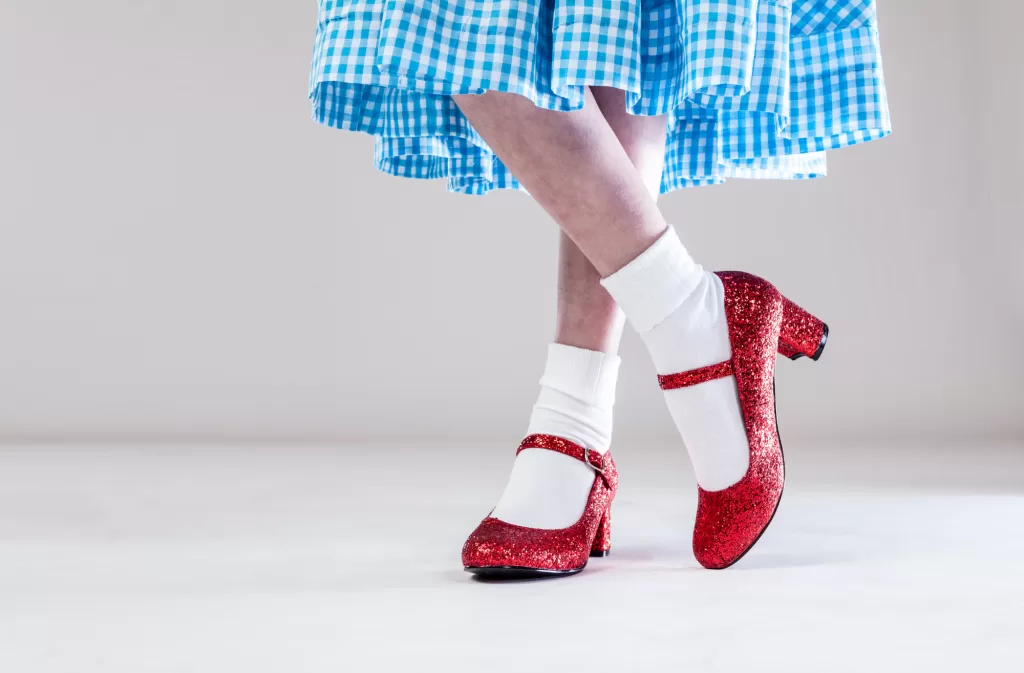
Maybe this is where the armor of light comes in. When we put on the armor of light, we are not putting on traditional chainmail, the kind that keeps us from being wounded. We are not putting on a costume that lets others pigeonhole us without ever getting to know us, like the pointy black hat of the Wicked Witch. Those are things that separate us from others instead of bringing us together. The armor of light is more like a new way of seeing, something that filters out our worst instincts and helps us see the world with more tenderness, more compassion, and more truth. Putting on the armor of light is putting on Christ Jesus himself. It is far more powerful than even a pair of ruby red slippers.
Unlike in Oz, truth-telling is not a dangerous thing in the kingdom of God. It is a prerequisite for a living a God-centered life. We tell the truth about ourselves, not letting others define us, even as we seek to better understand the truth about God, other people, and the whole created order. We don’t shirk from naming the spiritual forces of wickedness and the evil powers of this world, but nor do we demonize or scapegoat others, especially not those who are already vulnerable or marginalized.
I think this is why our Advent readings focus on staying awake, being alert. We are not being asked to be hyper-vigilant because of all those bad guys out there. We are encouraged to be awake to a deeper, fuller, more complex reality. Be awake to the twists and turns of history. Be aware that things are not always what they seem, and that rarely, if ever, is anyone or any situation all good or all bad. We don’t need a really good villain to unite us; we can be united by the vows we take at Baptism and renew today, vows that we will help CJ uphold as he grows in his Christian faith.
During Advent many of our readings will have an apocalyptic feel to them, and there is always a temptation, given everything that is going on all around us, to think that this time it really is the end of the world. When we get that feeling, let’s remember that the word apocalypse means unveiling. Advent, then, is a time to look behind the curtain. What will we find there? A charlatan, a huckster, a fraud? No, because we are not following the Yellow Brick Road; we are following a loving God, a patient and gracious savior who beckons us ever deeper to our truest and most loving selves. We are invited and encouraged to go to the house of the Lord, to turn our guns and bullets into plowshares, and to pray for peace in all the world. This Advent, let us go to the house of the Lord and prepare for the unveiling. What we will find there will change us, if we let it. Change us, as the song says, for the better, and for good. Amen.
OTHER RECENT SERMONS
- “Wondrous Strange”: Sermon by Mae Barnes 8/30/2026Sermon on August 30, 2026“Wondrous Strange”By: Mae Barnes, Guest Preacher “There are more things in heaven and earth, Horatio, than are dreamt of in your philosophy.” I’ve never been entirely certain if starting a sermon with a quote from Shakespeare is cliche or not, but by gum and by golly, I am nothing if not a sucker for the Bard. (And, if I know my audience, a fair amount of you fine folk are just as fond of him as I am.) For those who do not know or cannot remember the context of that line, it is spoken by…
- “Be Who God Created You to Be”: Sermon by Rev. Pamela 8/23/2026Sermon on August 23, 2026“Be Who God Created You to Be“By: The Very Rev. Pamela DolanPrimary scripture source: Matthew16:13-20 This summer, movie fans around the globe have been asking the same question: The Odyssey or Spider-Man? While not quite as big a cultural phenomenon as the summer of Barbenheimer, the success of both these films does seem to say something intriguing about the moment we’re living in. Some have opined that the endless stream of thought pieces about The Odyssey and the enormous popularity of Spider-Man suggest that we’re quietly longing for the days when we all watched the same…
- “Lost Sheep”: Sermon by Anthony Amato 8/16/2026Sermon on August 9, 2026“Lost Sheep”By: Anthony Amato, seminarian “I was sent only to the lost sheep of Israel. It is not fair to take the children’s food and throw it to the dogs.” If you’re anything like me, you might find it uncomfortable to hear Jesus speaking this way. A woman is coming to him in desperation, hoping that her daughter might be healed of her affliction, only to have Jesus resist her request. She’s a Gentile, a Canaanite, and Jesus insists that he has come only for the people of Israel. Jesus also uses a rather demeaning metaphor…
- “Faith and Trust”: Sermon by Rev. Maggie 8/9/2026Sermon on August 9, 2026“Faith and Trust“By: The Very Rev. Pamela Dolan May I speak in the name of the Father, the Son, and the Holy Spirit. Amen. 2026 has been a tumultuous year for me. Rounding out my final semester of seminary, getting engaged, moving across the country, and getting ordained. So many pieces of my daily routines have been upended right in front of my eyes. I knew most of these changes were coming and yet it felt kind of like being tied to the train tracks watching the train barrel towards you. I don’t know that the…