


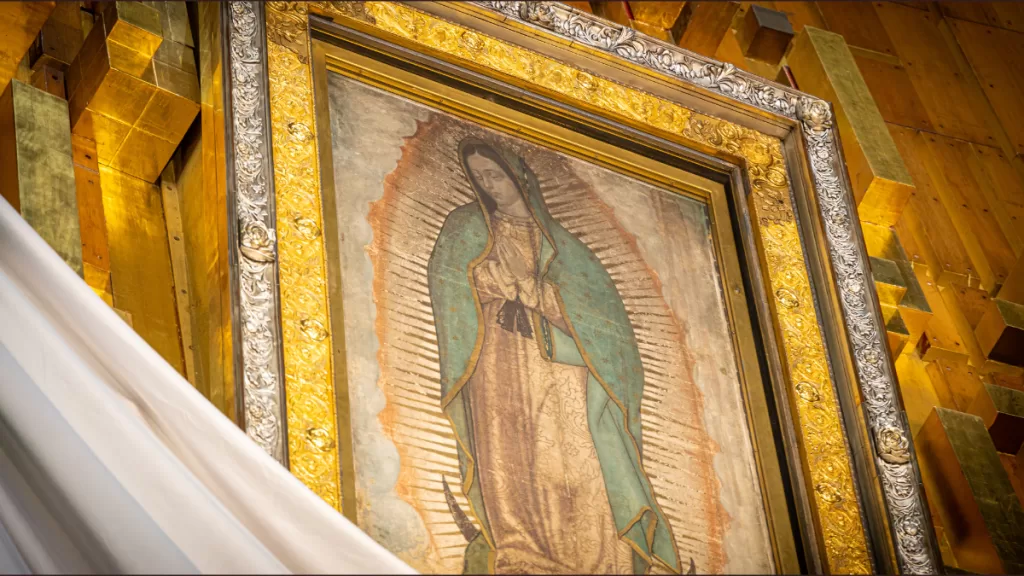
Sermon on December 14, 2025
“Mary, Mother of Joy“
By: The Very Rev. Pamela Dolan
If, like me, you are a woman who grew up Catholic, you might have a complicated relationship with Mary. You know Mary: the only person besides Jesus to have been born without the “stain of original sin,” the only woman to have both given birth and be praised for her lifelong virginity, and, last but not least, one of the only humans who was assumed into heaven without suffering physical death. Mary, who is both the Queen of Heaven and who is held up as a model of humility, passivity, and compliance. Like I said, it’s complicated.
Let me be clear that I do not in any way intend this sermon to be an anti-Catholic screed. Catholic theology and social teaching have shaped me for the better and, more importantly, have shaped some of the most important writers, mystics, artists, and activists to have ever lived.
It’s just that when I was a teenage girl with a wildly romantic imagination and teeteringly high intellectual ambitions, the version of Mary that I learned about in church didn’t seem like much a role model. She didn’t inspire a sense of solidarity or even hope; mostly, she made me feel like a failure before I’d even started.
At some level, the lesson I was taking in was that to be a good, faithful woman you had to be like Mary, and the only way to be like Mary was to be nothing like me. For one thing I wasn’t sure I wanted to be a mother (obviously I changed my mind about that later!), and for another thing I thought that creating an ideal of womanhood best captured with words like “vessel” or “handmaiden” was deeply problematic. (And that part I haven’t changed my mind about.)
And then came Our Lady of Guadalupe.
Some of you have heard me preach about her before, so I won’t go into the whole story in detail here. But at some point in my 20’s, I learned about the appearance of the Virgin Mary to Juan Diego, a poor, indigenous man living through the early days of Mexico’s colonization by Spain in the sixteen century. Mary not only appeared to him, she appeared as a young, brown-skinned indigenous woman, speaking an indigenous language, and raising the peasant Juan Diego to the level of a prophet who would be listened to by the rich and powerful in the Church. Together, Juan Diego and Mary, in the guise of the Virgin of Guadalupe, changed history.
This Mary, unlike the version of Mary I took in as a child, is an icon of solidarity, of liberation, of God’s preferential option for the poor. Or, as Christine Valters Paintner describes her, this is Mary as a mirror of justice.
This Mary is a visionary, a seer, a woman who is qualified to stand alongside John the Baptist as one of the great prophets of reversal and restitution. John ushers in an apocalyptic age, when the new life in Christ will be revealed to all. He urges us to repent and be washed in the waters of baptism, to give away any excess we have, and to prepare our hearts and minds for the arrival of God in our midst.
Mary, meanwhile, actually brings God into our midst, in her very belly, and ushers in new life on the waters of birth. The song she sings (to John’s mother, no less!) is a song of protest and a victory song, as she sees the reversal of fortune God so desires already coming to pass in the person of her beloved son.
It is in that prophetic, mystical sense that I think Our Lady of Guadalupe is the same Mary whose words leap out at us from the pages of Scripture. The passage from the Gospel of Luke we hear today, also known as the Magnificat, is where I most clearly see the coming together of the Mary we find in the Bible with the Mary who appeared in Mexico 1500 years later. As her soul proclaims the greatness of God and rejoices in God’s saving power, she is able to sing:
“He has shown the strength of his arm, he has scattered the proud in their conceit. He has cast down the mighty from their thrones, and has lifted up the lowly. He has filled the hungry with good things, and the rich he has sent empty away.”
This is as strong an indictment of the status quo as anything you will hear from the Old Testament prophets or the most zealous political reformers. Mary’s song is revolutionary, a cry of protest and resistance to all the forces of oppression, tyranny, and injustice that seek to destroy the goodness and beauty of God’s beloved creation. This Mary is anything but meek and mild. Rather, she is the woman clothed with the sun, crushing the serpent of empire and oppression under her feet.
In her book Birthing the Holy, Christine Valters Paintner has helped me see that the figure of Mary goes far beyond any binary description of her. What I learned about Mary when I was growing up wasn’t wrong, exactly, but it wasn’t the whole story.[i] Paintner’s book explores more than 30 archetypes connected to Mary, reminding us that nothing about our understanding of the holy should be simplistic or dualistic. She writes, “Mary has been called the mother of contemplatives as she models the essence of what it is to be an active co-creator and participant in the divine unfolding. She stands with one foot in the earthy, finite world and one in the infinite, luminous realm and bridges that gap in our hearts. […] There is a tradition of stories of the seven sorrows she had to bear. There is a parallel tradition of Mary’s seven rejoices. She is the container for our struggles and joys.”[ii]
That image of Mary as a bridge between two worlds is so resonant and wise. By bridging the gap between the earthy, finite world and the infinite, luminous realm, she is doing the same thing her son Jesus does. She reminds us that both realms are holy, sacred, beloved of God; we not only don’t have to choose between them, but in reality, we can’t. I also don’t have to choose between being like Mary and being myself. Arguably the most important thing that Mary did throughout her life was to say “yes” to God, and to do so wholeheartedly and with integrity. I, too, can say “yes” to joy, by being fully the person God created me to be, as can you and all of us.
There is one more gap that Mary and the Magnificat can help us bridge. That is between the sorrow of this world as we know it and the joy that God desires for us. That joy is not glib, superficial, or fleeting. It is a stream running deep underground, breaking into the open at the most unexpected moments. God created us in and for joy, just as he created the leviathan for the fun of it.
I know this is a very heavy morning in America, and in Australia, and in Gaza and Sudan and Ukraine, and in so many of our hearts. I admit that when my alarm went off I thought about pulling the covers back up over my head and not getting up. I didn’t want to drive through the cold and fog, but mostly I didn’t want to hear the news or think about the terrible stories that had been unfolding while I slept.
What got me out of bed and into the car was the glimpses of joy I find in our community. It was knowing that you all would be here this morning. It was remembering the warmth of the baptismal pool last Sunday, and the joyous dancing and giggling of children. It was picturing the steady flames of our Advent wreath, and the beauty of the rose-colored candle, the candle that calls us to joy.
Joy at its purest is a form of resistance and resilience. Unlike anxiety and fear and depression, joy is hard for empire to coopt or control. Joy is what “strengthens the weak hands and makes firm the feeble knees.” Joy is the water that breaks forth in the barren land and causes streams in the desert. Joy is what helps us be in it for the long haul. Joy is roses in the winter. Joy is the highway in the wilderness, leading us safely into the arms of a loving and liberating God. Amen.
[i] To be clear, the three Roman Catholic teachings mentioned in my introduction (the immaculate conception, perpetual virginity, and assumption of Mary, are not held in the same regard in the Episcopal Church.
[ii] https://abbeyofthearts.substack.com/p/the-wisdom-of-mary
OTHER RECENT SERMONS
- “Rich Man, Poor Man”: Sermon by Rev. Pamela 10/4/2026Sermon on October 4, 2026“Rich Man, Poor Man”By: The Very Rev. Pamela DolanPrimary scripture source: Luke 12: 13-21 Have you ever heard of the Windigo? I go out of my way to avoid scary stories, even during the “spooky season” of October, so the myth of the Windigo was new to me until quite recently. I promise I won’t include any graphic details, but I do want to share an explanation of the myth from the author Robin Wall Kimmerer, who writes, “The ‘monster’ in Potawatomi culture is Windigo, who suffers from the illness of taking too much and sharing…
- “Wilderness Lessons”: Sermon by Rev. Pamela 9/20/2026Sermon on September 20, 2026“Wilderness Lessons”By: The Very Rev. Pamela DolanPrimary scripture source: Exodus 16:2-15 When I was in grade school, I fell in love with the character of Eloise, the little girl who lived in luxury in the Plaza Hotel in Manhattan. Her escapades were the stuff of breathtaking fantasy to me. Imagine living like that! In a penthouse! With doormen and bell boys at your beck and call and room service available all hours of the day and night! Maybe you can’t imagine it, but I sure could! I grew up up in Hawaii with four older siblings,…
- “Wondrous Strange”: Sermon by Mae Barnes 8/30/2026Sermon on August 30, 2026“Wondrous Strange”By: Mae Barnes, Guest Preacher “There are more things in heaven and earth, Horatio, than are dreamt of in your philosophy.” I’ve never been entirely certain if starting a sermon with a quote from Shakespeare is cliche or not, but by gum and by golly, I am nothing if not a sucker for the Bard. (And, if I know my audience, a fair amount of you fine folk are just as fond of him as I am.) For those who do not know or cannot remember the context of that line, it is spoken by…
- “Be Who God Created You to Be”: Sermon by Rev. Pamela 8/23/2026Sermon on August 23, 2026“Be Who God Created You to Be“By: The Very Rev. Pamela DolanPrimary scripture source: Matthew16:13-20 This summer, movie fans around the globe have been asking the same question: The Odyssey or Spider-Man? While not quite as big a cultural phenomenon as the summer of Barbenheimer, the success of both these films does seem to say something intriguing about the moment we’re living in. Some have opined that the endless stream of thought pieces about The Odyssey and the enormous popularity of Spider-Man suggest that we’re quietly longing for the days when we all watched the same…