


Sermon on July 12, 2026
“The Sower”
By: Kimo Kimokeo
I think that we’re fortunate to live in the Central Valley of California, especially this time of the year when garden vegetables and fruit are coming into season. In my neighborhood, plums, peaches, and English walnuts are being shared. Today’s Gospel touches on growing things and harvesting.
In the 13th Chapter of Matthew, we read about Jesus sharing His story or the Parable of the Sower. We learn that it is a large crowd that Jesus is speaking to. If you’re like me, you may wonder did Jesus always draw a large crowd? Well I went to Matthew 12 and found that Jesus had been causing quite a stir in his public ministry and quite a stir with the Pharisees or religious leaders at that time. Specifically, Jesus was saying and doing things about the Sabbath that challenged the Pharisees who were pretty much the Mosaic Law Police.
The Mosaic Law—or the Law of Moses—was the 613 commandments that were passed down from God to the Israelites through Moses. These laws were the guide for Israel’s moral, civil, and ceremonial life and are found today in the first five books of the Bible.
The most recent conflict we learn of in Matthew 12 involves lots of drama related to what was not permissible on the Sabbath. It starts with Jesus’ disciples picking and eating some wheat or barley as they were walking through a field. Then there’s a situation at the synagogue when Jesus heals a man with a withered hand. There’s a lot of drama which eventually leads to a plot by the Pharisees to kill Jesus.
So Jesus leaves the area and continues to heal people. This takes us to the shore of the Sea of Galilee, a large freshwater lake today we know as Lake Tiberias—in Hebrew called Yam Kinneret. Matthew says the crowd was so large that Jesus ended up in a boat in the water so people could see and hear him. There obviously was a lot of talk of Jesus’ preaching, so I think people were anxious and curious about what Jesus was going to say NOW! Maybe he’d have a rebuttal to what was being said that happened earlier or maybe a clarification of what he meant when he said the Son of Man is Lord of the Sabbath?
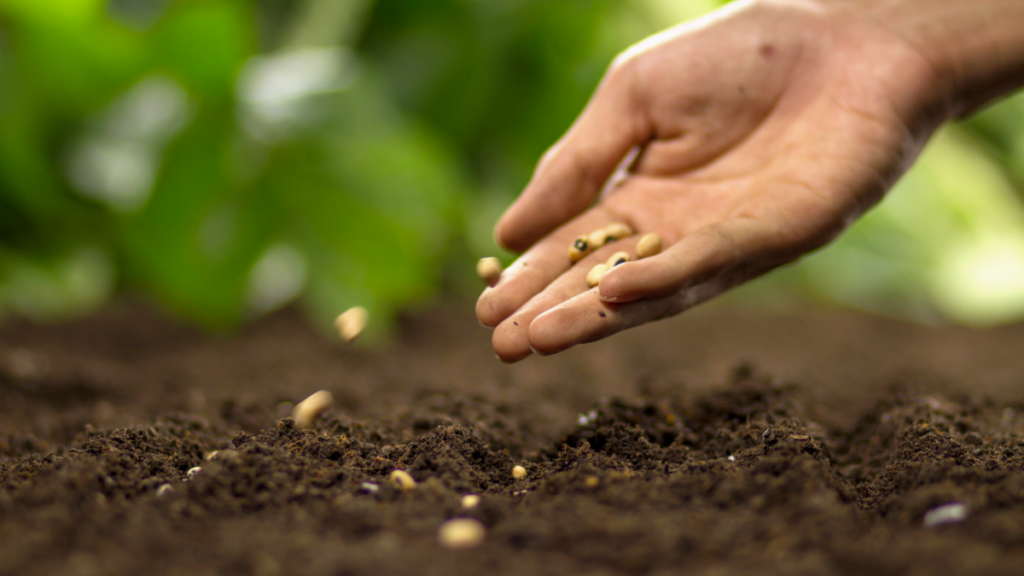
But NOPE, NOPE, Jesus talks about seeds, about a Sower of seeds. If I had been there, I would have really been expecting something else. Jesus tells us the Sower is spreading the seed across the landscape, and seeds fall on a well-used path, and these seeds were almost immediately eaten by birds. Some seeds also land on the rocky ground and when the seeds grew there wasn’t much soil to take root in and the hot scorching sun just withered them away. The Sower’s seeds continue to fall amidst a patch of weeds, and thorns and those seeds were choked out in the competition for space. But some seeds fall on good soil and these seeds bring forth either wheat or barley some hundredfold, some sixtyfold, some thirtyfold.
Now for a point of order here from the non-Math guy: According to what I dug up (pun intended) an average or expected crop harvest in ancient Palestine was usually a 10-fold yield (meaning 10 grains harvested for every single seed planted). So with this baseline a truly bountiful harvest was defined by anything higher. Thus, 30-fold would be considered exceptional, 60-fold remarkable, and 100-fold an absolute miracle of divine favor.
Jesus adds at the end of his parable, “Let anyone with ears listen.” Jesus was saying that to the crowd along the shore of the lake; he was saying it to his disciples and saying this to us today.
We know from theologians that Jesus used parables a lot in his public preaching. There are over 20 parables that are documented in the Gospel of Matthew alone.
(I’ve got the list in my pocket if you want to check it out!)
Theologians tell us that Jesus used parables to both reveal and conceal spiritual truths, and Jesus’ Parable of the Sower meets the mark. To the religious leaders and the hardened crowds who rejected the plain truth of Matthew 12, this parable was just a boring story about farming. To the disciples and those followers of Jesus who had ears to hear, this parable was a prompt to lean in, ask questions, and discover the spiritual truths.
The seeds that fall off the path are those people who do not understand what is being said and are drawn away. The seeds on the rocky soil hear the Gospel, understand it immediately, and receive it with joy, but when trouble or persecution arrives they don’t have enough depth and understanding and are drawn away. Those seeds in the weeds and thorns are those who receive the Gospel and Grace, but are too distracted by the cares and powers and busyness of the world; they get distracted and are drawn away. But then there are the seeds that fall on the good soil. These are folks who yield to the Gospel and Grace of God, understand it, and bear much fruit of the Kingdom of God.
Now if you’re like me there’s that voice inside going “oh me or my, just what kind of soil am I? I mean I am leaning hard into the good soil, but I have the essence of distractions that get in the way with some occasional moments of hard path.
Well thankfully, thankfully theologians offer us other perspectives of this parable, a perspective that doesn’t lock me, doesn’t lock you in, doesn’t lock us in being on only one soil type forever. Instead, all the soils serve as snapshots of how we respond to God at different times and seasons in our journey of faith.
In his book, The Parables of the Kingdom, Episcopal priest, theologian, and food writer the Rev. Robert Capon urges us to focus away from soil management and focus on God the Sower and God’s absolute extravagance in sowing His Grace. Rev. Capon says God does not practice targeted farming. God’s grace is universally scattered across all places and all people with no discrimination. Ready or not, God’s grace is scattered throughout our world and our true response is not about tracking our good deeds or moral status. Our response is to bear fruit by abiding in His word, letting the Spirit of God play out in us, and not getting in the way.
Amen!
[1] https://www.atlasobscura.com/articles/wheats-evil-twin-has-been-intoxicating-humans-for-centuries, retrieved on 7-16-26.
[2] Walter J. Burghardt, “Contemplation: A long loving look at the real,” Church, Winter 1989, p. 15.
[3] From The Baptismal Covenant, The Book of Common Prayer 1979, p. 305.
[4] To learn more about the Episcopal Church’s view of Christian nationalism, see the webinar “Essential Conversations: The Sin of Christian Nationalism,” at https://www.youtube.com/watch?v=wmNX8mlh2Ps. See also The Crisis of Christian Nationalism: Report from the House of Bishops Theology Committee (Church Publishing, Inc., 2024).
OTHER RECENT SERMONS
- “Stay in Your Lane”: Sermon by the Ven. Margaret 7/19/2026Sermon on July 19, 2026“Stay in Your Lane“By: The Ven. Margaret Grayden If you’ve been out and about lately, riding a bike or driving a car around Davis, you may have noticed that many of our streets are not in good shape—crumbling pavement and lane lines so faded in some places as to be practically invisible. Back when dinosaurs roamed the earth and I learned how to drive, one of the phrases I heard a lot was “Stay in your lane!” This, it turns out, is good advice, not only for driving but for many other activities in life. I’ve…
- “The Sower”: Sermon by Kimo Kimokeo 7/12/2026Sermon on July 12, 2026“The Sower”By: Kimo Kimokeo I think that we’re fortunate to live in the Central Valley of California, especially this time of the year when garden vegetables and fruit are coming into season. In my neighborhood, plums, peaches, and English walnuts are being shared. Today’s Gospel touches on growing things and harvesting. In the 13th Chapter of Matthew, we read about Jesus sharing His story or the Parable of the Sower. We learn that it is a large crowd that Jesus is speaking to. If you’re like me, you may wonder did Jesus always draw a large…
- “An Ecosystem of Love”: Sermon by Rev. Pamela 5/31/2026Sermon on May 31, 2026“An Ecosystem of Love“By: Rev. Pamela Dolan When I was in middle school, I briefly took part in a confirmation class at my local Roman Catholic parish. I say “briefly,” because I’m not sure how many classes I attended, but I know that I did not go on to be confirmed with the rest of the class. I vaguely remember being told that Confirmation is an affirmation of faith, a time when we choose to make a mature commitment to the promises made on our behalf at Baptism. And I definitely remember telling my mother that…
- “Set Free”: Sermon by Rev. Debbie 5/17/2026Sermon on May 17, 2026“Set Free“By: Rev. Debbie Hawkins Set free. Sometimes I worry about being found acceptable in God’s sight, about accumulating enough “brownie points,” as someone recently put it, to be considered worthy of heaven or God’s care. I worry I need to do something to make sure God loves me, notices me, but maybe not too much, hoping whatever it is I am doing will lead God to say, “well done, good and faithful servant, now enter into the joy of your master.” Jesus even suggests we should be thinking like this or at least he tells…