


Sermon on February 18, 2026
“Ashes and Dust”
By: The Ven. Margaret Grayden
Readings: Matthew 6:1-6, 16-21
I’ve always found more than a little irony in the Ash Wednesday service. We’ve just heard Jesus warn us against wearing signs of piety on our foreheads like the hypocrites. Yet later in this service, we will have an opportunity to receive the imposition of ashes in the form of a cross on our foreheads. Wait, what? A large, dark, smudged cross seems like an obvious sign of piety, doesn’t it?
Some of us debate each year what to do about the ashes on our foreheads after the service—do we leave them on or do we wipe them off so as to avoid any hint of an ostentatious display of piety? I’m not going to tell you which way is right—you’ll have to discern that for yourselves. I will note that the ashes are meant to remind us of our mortality, not to remind others of our piety. It is the intention that matters, because we can’t control what other people choose to believe about our actions.
The Gospel appointed for this day brings that message home. Prayer, fasting, and almsgiving were traditional Jewish practices of piety in 1st-Century Palestine. So it is important to understand that Jesus is not condemning those practices. The very way He phrases His teaching assumes that people will engage in these disciplines—Jesus says, “when you pray,” “when you fast,” “when you give alms” (emphasis added). He is teaching his followers the importance of the spirit in which one does these acts—the intention behind them. He is reminding His followers that outward actions should not be intended to impress others—what others believe doesn’t matter; God matters, and God sees through and beyond our actions to the intentions in our hearts.
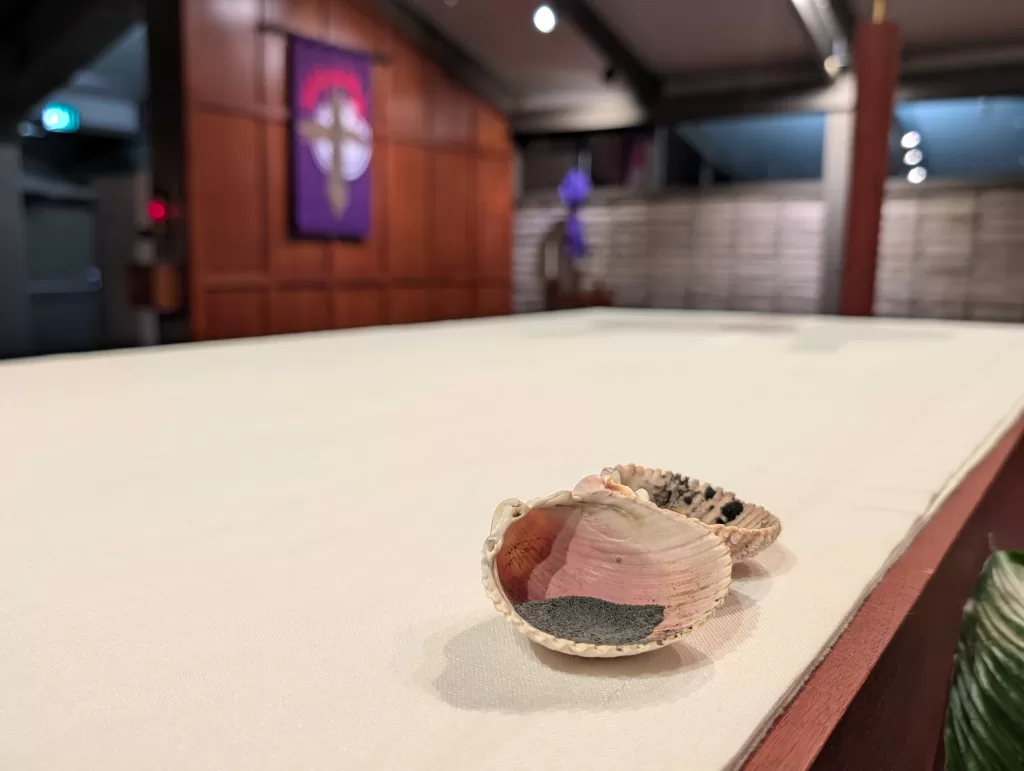
In a few minutes, we will be invited to come to the altar, where, as we stand or kneel in silence, a priest will mark the sign of the cross in ashes on our forehead and tell us: “Remember that you are dust, and to dust you shall return.” Ashes and dust. I have always found this ritual deeply moving—beautiful in its stark simplicity. I have treasured not only receiving ashes myself, but also the opportunity to impose them.
Well, I have a confession to make—it is that time of year, after all. I’ve always assumed that ashes and dust are basically the same thing—signs of death, reminders that life is finite, that we and all living things eventually come to an end. But ashes and dust are not the same. Ashes are the product of combustion—they are what is left when everything else has been destroyed. Dust is organic matter, albeit on a microscopic scale—traces of life, not evidence of death. As Episcopal priest Phil Hooper notes, ashes and dust “…come from different places and point to different truths. They are, in fact, two symbols attempting to operate as one.”[1] Think about that for a moment. We wear ashes on our forehead as a reminder of our mortality, but those ashes are imposed with words of life: “Remember that you are dust, and to dust you shall return.” We are created out of dust[2] (that is, from life), we die, and in dying, we enter into new life. Ash Wednesday actually calls us to recognize that paradox and commit to living our lives fully, in wonder and gratitude, even as we humbly hold in our awareness our mortality—and Ash Wednesday calls us to do so not only for the 40 Days of Lent, but for all of our lives.
There’s a beautiful tale from Hasidic Judaism that offers a helpful image of how this works. A rabbi once told his disciples that everyone must have two pockets, each one with a slip of paper in it, so that at any time, one could reach into a pocket as needed and be reminded of a vital truth. In one pocket, the slip of paper says: for my sake the world was created. In the other pocket, the slip of paper says: I am but earth and ashes.[3] That is to say, we must always remember that we are infinitely precious, beloved by the God who created us from the earth to enjoy life fully. And we must always remember that we are earth, and to earth we shall return. Life, then, is the act of balancing joy and humility. We are called to live joyfully and make the best use of the time we have to make the world a better place. Certainly, we need to reflect and repent when we miss the mark. And we need to accept God’s forgiveness and grace. We are, after all, an Easter people–we know that the darkness of the crucifixion is not the end of the story.
I’d like to leave you with this poem from Jan Richardson, a United Methodist minister, author, and artist. It’s called “Blessing the Dust.”[4] I think it is a powerful reminder of the message of life and hope that lives in the ashes of Ash Wednesday.
All those days
you felt like dust,
like dirt,
as if all you had to do
was turn your face
toward the wind
and be scattered
to the four corners
or swept away
by the smallest breath
as insubstantial—
Did you not know
what the Holy One
can do with dust?
This is the day
we freely say
we are scorched.
This is the hour
we are marked
by what has made it
through the burning.
This is the moment
we ask for the blessing
that lives within
the ancient ashes,
that makes its home
inside the soil of
this sacred earth.
So let us be marked
not for sorrow.
And let us be marked
not for shame.
Let us be marked
not for false humility
or for thinking
we are less
than we are
but for claiming
what God can do
within the dust,
within the dirt,
within the stuff
of which the world
is made,
and the stars that blaze
in our bones,
and the galaxies that spiral
inside the smudge
we bear.
AMEN.
[1] Phil Hooper, “Ash/Dust, Ash Wednesday,” Sermons That Work, February 18, 2026. https://www.episcopalchurch.org/sermon/ash-dust-ash-wednesday-february-18-2026.
[2] Genesis 2:7
[3] Martin Buber, Tales of the Hasidim, Book Two: The Later Masters (New York, NY: Schocken Books, 1947), pp. 249-50.
[4] Jan Richardson, Circle of Grace: A Book of Blessings for the Seasons (Orlando, FL: Wanton Gospeller Press, 2015), pp. 89-90
OTHER RECENT SERMONS
- “Ashes and Dust”: Sermon by the Ven. Margaret Grayden 2/18/2026Sermon on February 18, 2026“Ashes and Dust”By: The Ven. Margaret GraydenReadings: Matthew 6:1-6, 16-21 I’ve always found more than a little irony in the Ash Wednesday service. We’ve just heard Jesus warn us against wearing signs of piety on our foreheads like the hypocrites. Yet later in this service, we will have an opportunity to receive the imposition of ashes in the form of a cross on our foreheads. Wait, what? A large, dark, smudged cross seems like an obvious sign of piety, doesn’t it? Some of us debate each year what to do about the ashes on our foreheads…
- “The Mountaintop”: Sermon by the Rev. Ernie Lewis 2/15/2026Sermon on February 15, 2026“The Mountaintop”By: The Rev. Ernie LewisReadings: Exodus 24:12-182 Peter 1:16-21Matthew 17:1-9 This is the last Sunday after the Epiphany. The baby in the manger has become a grown man. He’s gotten quite a reputation as a teacher and a miracle worker. He’s gathered a small group of close followers who travel the countryside with him. Some of his followers even dare to suspect he might be the Messiah, the One promised so long ago to the Jewish people. His name is Jesus and he has a growing following, as well as a particular ability to send…
- “Salt of the Earth”: Sermon by Kimo Kimokeo 2/8/2026Sermon on February 8, 2026“Salt of the Earth”By: Kimo KimokeoReadings: Matthew 5:13-20 Our gospel reading for this Sunday has us continuing in Matthew 5 with Jesus still speaking to the large crowd on the mountain side—a crowd made up of His Disciples, others who are curious, folks who may be just seekers checking this Jesus who has been preaching and healing people of all kinds of ailments in Galilee and an area made up of ten cities called the Decopolis, as well as Jerusalem, Judea and scripture says beyond the Jordan. Though there were different reasons for those in the…
- “Good News”: Sermon by Rev. Pamela 2/1/2026Sermon on February 1, 2026“Good News”By: The Very Rev. Pamela DolanReadings: Matthew 5:1-12 “Jesus went throughout all Galilee, teaching in their synagogues and proclaiming the good news of the kingdom and curing every disease and every sickness among the people. So his fame spread throughout all Syria, and they brought to him all the sick, those who were afflicted with various diseases and pains, people possessed by demons or having epilepsy or afflicted with paralysis, and he cured them. And great crowds followed him from Galilee, the Decapolis, Jerusalem, Judea, and from beyond the Jordan” Matthew 4:23-25 These lines come just before today’s passage…